
Table of Contents
Surface mount technology (SMT) assembly remains the backbone of modern electronics manufacturing. As product complexity increases and tolerances tighten, consistent quality can no longer be achieved through equipment capability alone. It requires a disciplined, data-driven approach to SMT assembly line optimization.
For OEMs, understanding how SMT lines are optimized for PCB assembly manufacturing helps set realistic expectations for yield, reliability, and scalability. It also highlights why early alignment with an EMS partner is critical to long-term program success.
Consistency Starts With Solder Paste Printing
Solder paste deposition remains one of the most critical and failure-sensitive steps in SMT assembly. Variations introduced at the print stage can propagate through the rest of the process, impacting placement accuracy, solder joint integrity, and defect rates.
Optimized SMT lines focus heavily on stencil design, paste selection, printer setup, and environmental control. Aperture geometry, stencil thickness, and board support strategies must be matched to component size and pad design. Even small deviations in paste volume can result in insufficient solder, bridging, or tombstoning.
Solder paste inspection plays a key role in maintaining consistency. By measuring paste height, volume, and area, manufacturers can detect trends such as stencil wear or misalignment before defects occur downstream.
Placement Accuracy and Machine Programming Discipline
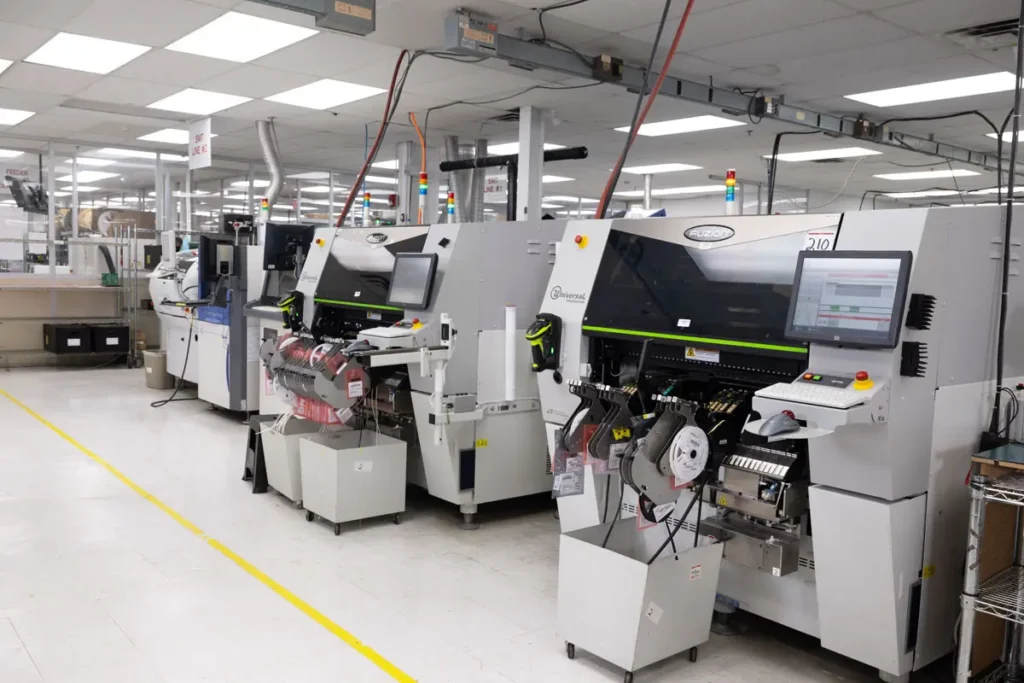
High-speed placement equipment can achieve remarkable accuracy, but consistent results depend on disciplined programming and maintenance practices.
Component libraries must be accurate and validated. Incorrect package data, pickup points, or rotation values introduce variability that no amount of downstream inspection can fully correct. Feeder condition, nozzle selection, and component presentation also influence placement consistency.
Optimized SMT lines emphasize standardized programming practices, regular machine calibration, and controlled change management. For OEMs, this translates to fewer surprises when designs transition from prototype to volume production.
Reflow Profile Optimization and Thermal Control
In PCB Assembly, reflow soldering is where the solder joint is formed, making thermal control essential to quality and reliability. PCB boards with mixed component sizes, varying thermal mass, or advanced materials require carefully tuned reflow profiles.
An optimized SMT line does not rely on generic profiles. Instead, profiles are developed based on actual printed circuit board characteristics, component sensitivity, and solder paste requirements. Temperature ramp rates, soak times, peak temperatures, and cooling rates are all adjusted to achieve proper wetting without damaging components.
Thermal profiling should be revisited whenever significant design or material changes occur. Consistent quality depends on maintaining process stability as products evolve.
Inline Inspection as a Process Control Tool
Inspection systems are most effective when used as part of a broader process control strategy rather than as simple pass fail checkpoints.
Automated optical inspection after placement and reflow provides early feedback on component alignment, solder joint formation, and polarity. When integrated with process data, AOI results help identify root causes such as print variation, placement drift, or profile changes.
Optimized SMT lines use inspection data to drive corrective actions upstream, reducing rework and improving overall yield.
Material Handling and Environmental Stability
Material handling and environmental conditions often receive less attention than equipment selection, yet they play a significant role in SMT consistency.
Moisture-sensitive components must be stored and handled correctly to prevent popcorning or latent reliability issues. Solder paste requires controlled storage, handling, and usage time to maintain performance. Temperature and humidity variations on the production floor can affect paste behavior and component placement.
Well-optimized lines enforce material control procedures and monitor environmental conditions as part of their quality system.
Process Documentation and Traceability
Consistent quality depends on repeatability, and repeatability requires documentation. Optimized SMT assembly lines maintain detailed records of machine programs, process parameters, inspection results, and material usage.
Traceability systems link this information at the board or serial number level, enabling faster root cause analysis and continuous improvement. For OEMs operating in regulated or high-reliability markets, this level of documentation is often a baseline requirement.

What SMT Line Optimization Means for OEMs
SMT assembly line optimization is not a single improvement or capital investment. It is an ongoing discipline that integrates equipment capability, process control, data analysis, and operator expertise.
OEMs that partner with EMS providers focused on optimization benefit from higher yield, more predictable schedules, and improved product reliability. Early engagement allows design, materials, and process decisions to support stable PCB assembly manufacturing from the start.
At Foxtronics EMS, SMT line optimization is a core part of how we support customer programs. Through disciplined process control, advanced inspection, and collaborative engineering support, we help OEMs achieve consistent quality across prototype, ramp, and volume production.
Partner with Foxtronics EMS to optimize your SMT assembly line, boost yields, and streamline schedules—your trusted partner in PCB assembly manufacturing.